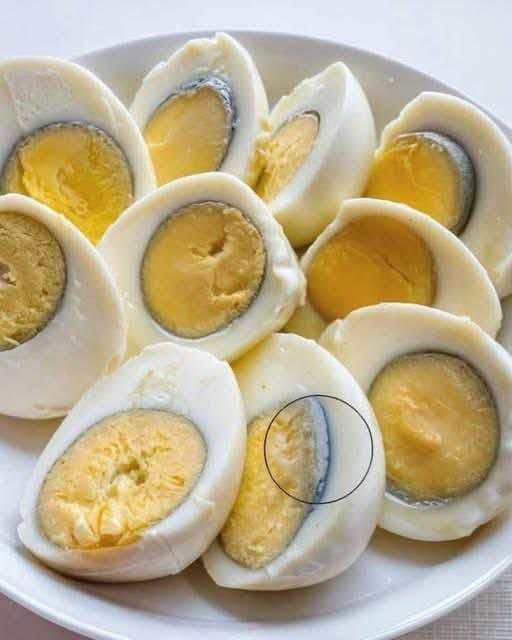
…it means they are overcooked.
That grayish-green ring is completely harmless, but it’s a sign that the egg was left in hot water too long. Scientifically, it happens when the sulfur in the egg whites reacts with the iron in the egg yolks to form ferrous sulfide. It also gives the yolk a chalky texture and a slightly sulfurous smell.
The Perfect Hard-Boiled Eggs Recipe
To get perfectly tender whites and bright, creamy yellow yolks without that green ring, you need to control the residual heat. This foolproof “stove-off” method works every single time.
Ingredients & Tools
- Eggs: Large eggs (older eggs peel much easier than fresh-off-the-farm ones).
- Water: Cold water to cover the eggs by at least an inch.
- Ice Bath: A bowl filled with cold water and ice cubes.
Step-by-Step Method
- Start in cold water
Preparation
Place your eggs in a single layer at the bottom of a saucepan. Pour cold water over them until they are submerged by about 1 inch (2.5 cm). Starting with cold water ensures the eggs heat up evenly. - Bring to a rolling boil
High heat
Place the pan over high heat uncovered. Watch it closely until it reaches a full, rolling boil. - Cover and kill the heat
12 minutes (Stove OFF)
The moment the water boils, remove the pan from the heat source completely and put a lid on it. Leave it alone for exactly 12 minutes for a perfect hard boil (or 9 minutes if you prefer a slightly creamier medium-hard center). - Shock in an ice bath
5 minutes
While the eggs sit, prepare your ice bath. As soon as the timer goes off, immediately transfer the eggs into the ice water using a slotted spoon. Leave them there for at least 5 minutes.
Why the ice bath is non-negotiable: The ice water rapidly drops the temperature, instantly stopping the cooking process so the ferrous sulfide ring can’t form. It also shrinks the egg slightly inside the shell, making them incredibly easy to peel.
To peel, gently tap the egg on a hard surface to crack it all over, then roll it between your hands and start peeling from the wider bottom end where the air pocket sits. Peeling them under running tap water helps slide the shell right off.