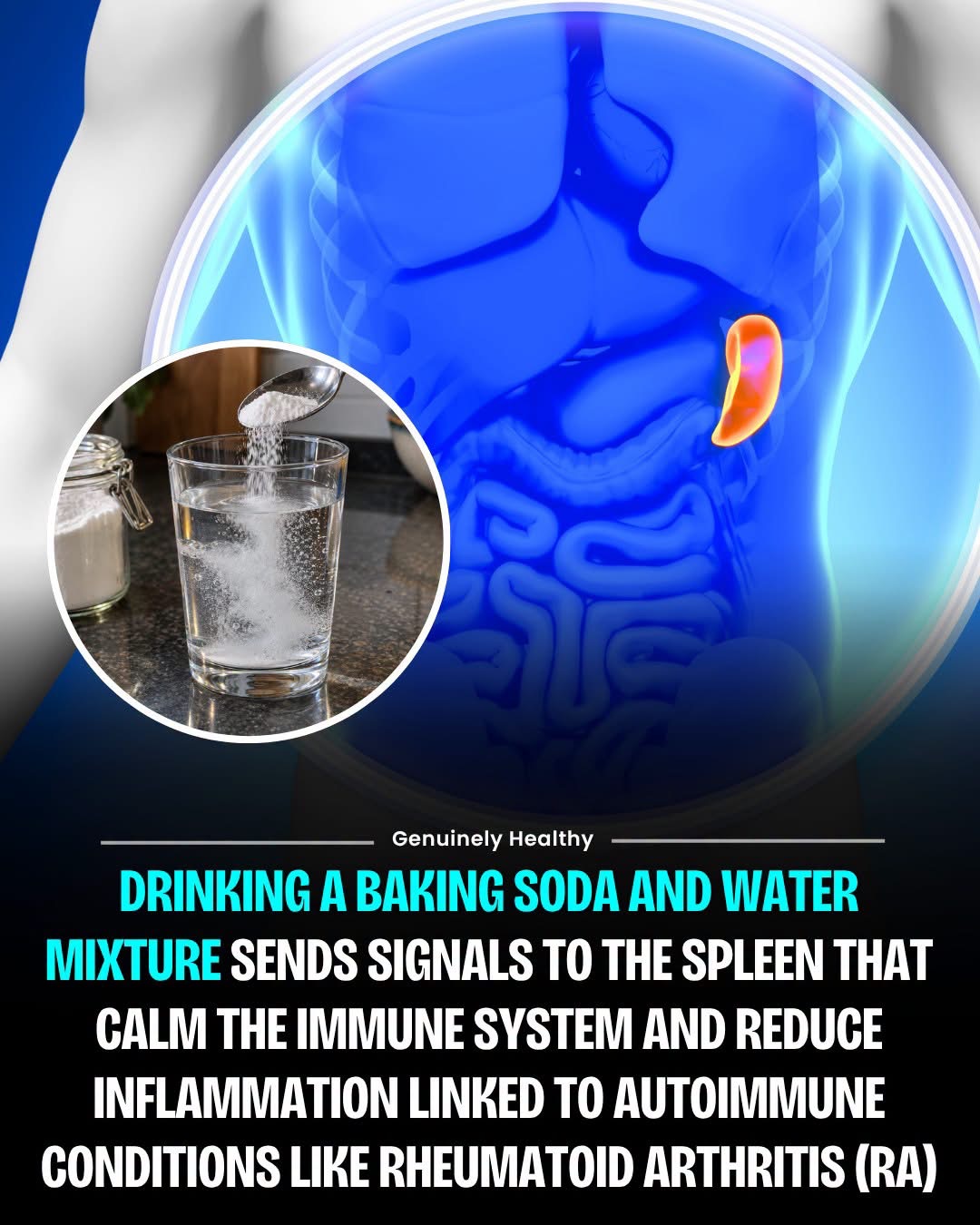
Baking Soda and Water: What the Research Really Says About Inflammation
A simple mixture of baking soda and water has attracted attention because of research from the Medical College of Georgia at Augusta University. Scientists investigated whether oral sodium bicarbonate could influence the immune system and the spleen, an important organ involved in immune regulation.
The study, published in The Journal of Immunology in 2018, reported that sodium bicarbonate ingestion was associated with changes in immune-cell activity. In particular, researchers observed a shift in macrophages from a predominantly pro-inflammatory M1 profile toward a more regulatory, anti-inflammatory M2 profile. Similar changes were observed in the blood of human participants.
The “Recipe”
Ingredients
- Drinking water
- Food-grade sodium bicarbonate (baking soda)
Important preparation note
There is no medically established recipe or recommended daily dose of baking soda for treating inflammation or autoimmune disease. The amount and schedule used in research should not automatically be copied as a home treatment.
If baking soda is being used as an antacid, use a commercially labeled product according to its package directions rather than following social-media recipes.
Basic preparation concept
For people who have been specifically advised by a healthcare professional to use sodium bicarbonate orally, it is generally mixed thoroughly into water before drinking.
Do not increase the amount because you believe a stronger mixture will produce a stronger anti-inflammatory effect.
What Did the Study Find?
The researchers were interested in how sodium bicarbonate might communicate with the immune system.
After oral sodium bicarbonate administration, researchers observed changes involving the spleen and immune cells. They reported that macrophages shifted toward a more regulatory M2 phenotype, while other immune changes were also observed.
The researchers proposed that the effect may involve mesothelial cells associated with the spleen and signaling involving acetylcholine. Their findings suggested that sodium bicarbonate could activate a pathway that influences the body’s inflammatory response.
Does This Mean Baking Soda Treats Rheumatoid Arthritis?
No.
This is the most important distinction.
The research provides interesting evidence about how sodium bicarbonate may influence immune signaling, but it does not prove that drinking baking soda cures, prevents, or treats rheumatoid arthritis or another autoimmune condition.
The Augusta University researchers themselves described the work as evidence that could potentially lead to future therapeutic approaches. Further research is necessary before sodium bicarbonate can be considered an established treatment for autoimmune disease.
Why Is the Spleen Important?
The spleen is part of the immune system and helps filter blood while participating in immune responses.
Researchers found that oral sodium bicarbonate affected immune activity involving the spleen. Their experiments suggested that mesothelial cells covering the spleen may play an important role in transmitting signals associated with the response.
This is one reason the study received significant attention: it suggested that a substance traditionally thought of mainly as an antacid could have effects beyond the digestive system.
What Are M1 and M2 Macrophages?
Macrophages are immune cells that perform many different functions.
In simplified terms:
- M1 macrophages are commonly associated with inflammatory immune responses.
- M2 macrophages are generally associated with regulatory and tissue-repair functions.
The researchers observed a shift toward the M2 phenotype following sodium bicarbonate ingestion.
However, the immune system is extremely complicated, so this finding should not be interpreted as meaning that simply drinking baking soda will “turn off inflammation.”
Safety Matters
Baking soda contains a significant amount of sodium. Taking too much can cause problems, particularly in people with certain medical conditions.
People should be especially cautious if they have:
- High blood pressure
- Kidney disease
- Heart disease
- Heart failure
- A sodium-restricted diet
- Problems with fluid retention
- Certain electrolyte or acid-base disorders
Baking soda can also interact with some medications and can cause digestive symptoms when consumed improperly.
For these reasons, do not use large amounts of baking soda as a daily wellness drink without medical advice.
A Better Takeaway
The research behind the viral claim is genuine and interesting. Scientists at Augusta University reported that oral sodium bicarbonate influenced immune signaling involving the spleen and was associated with a shift in macrophage activity toward a more anti-inflammatory profile.
But the study should not be presented as proof that baking soda water treats autoimmune diseases.
Think of it as an interesting research finding—not a replacement for prescribed medication, medical treatment, or professional advice.
Suggested Facebook caption
Can baking soda influence the immune system? 🥄
A fascinating 2018 study from researchers at Augusta University found that oral sodium bicarbonate was associated with changes in immune activity involving the spleen, including a shift in macrophages toward a more regulatory profile.
But there’s an important catch: this does not prove that baking soda water treats rheumatoid arthritis or other autoimmune diseases.
The science is interesting—but don’t turn a research finding into a home treatment without talking to a healthcare professional first.